Residential Solar — Net Metering
Net Metering in the Philippines
Your system is installed and generating power. Now comes the part most solar buyers overlook until it's too late: net metering. This section covers what it actually pays you, what you need to do to get it, and why you might not even want it.
The Export Rate Gotcha
You Don't Get Full Retail Credit
Net metering credits are not equal to what you pay per kilowatt-hour. Here's the math that changes every calculator you've seen:
- You pay Meralco approximately ₱13.17/kWh (total residential rate, Feb 2026)
- Net metering only credits the generation charge: approximately ₱7.86–8.39/kWh (fluctuates monthly)
- That means you get back roughly 40–60% of what you pay per unit exported
- The rest — transmission charges, distribution charges, taxes — you never recover on exported energy
The key insight is that self-consumption beats exporting every time. When you use solar power directly during the day, you save the full ₱13+/kWh. When you export excess to the grid, you only receive ₱5–8/kWh in credit. This single fact should drive how you size your system: design for maximum self-consumption, not maximum export. A smaller system that covers your daytime load earns more value per watt than an oversized one pushing surplus to the grid at a discount.
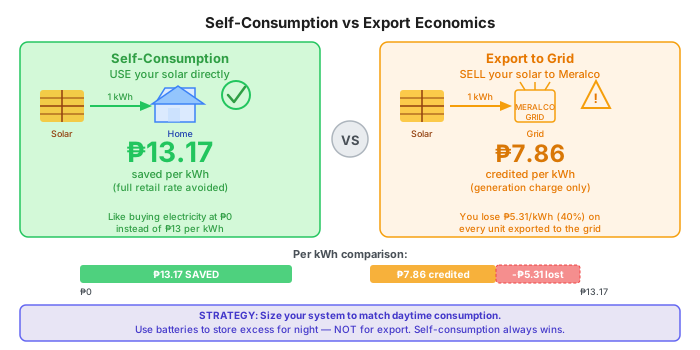 Using 1 kWh of solar directly saves the full ₱13.17 retail rate. Exporting that same kWh earns only ₱7.86 — a ₱5.31 loss per unit sent to the grid. Strategy: size for self-consumption, store excess in batteries.
Application Process
Getting a bidirectional meter installed is a multi-agency process with several handoffs. Here is the typical flow for Meralco customers:
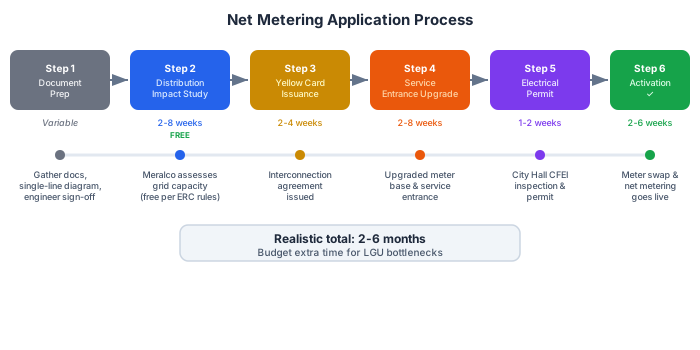 The 6-step net metering application process — budget 2-6 months from start to activation.
Step 1 — Document Prep: Gather your system documents before you do anything else. You'll need the solar installer's permit, technical specifications of your inverter and panels, the single-line diagram of your installation, and proof of a licensed electrical engineer's sign-off.
Step 2 — Distribution Impact Study: Meralco assesses whether the local distribution network can handle your export. Under 2025 ERC rules this study is free of charge. It used to be a common upsell opportunity; that loophole is now closed.
Step 3 — Yellow Card Issuance: Meralco issues an interconnection agreement. This is the green light that your system is technically cleared for grid connection.
Step 4 — Service Entrance Upgrade: Depending on your current panel setup, Meralco may require an upgraded service entrance (the point where Meralco's power line connects to your home — the wires, meter base, and main breaker at the entry point) or new metering socket to accept a bidirectional meter (a meter that can measure electricity flowing both ways — into your home AND back to the grid).
Step 5 — Electrical Permit (City Hall): Your local government unit (LGU) must issue a Certificate of Final Electrical Inspection (CFEI). This is where timelines get unpredictable.
Step 6 — Net Metering Activation: Once all permits are in order, Meralco schedules the meter swap and activates net metering on your account.
2026 DOE Mandate
Under the latest DOE rules, LGUs must issue electrical permits within 3 working days and CFEIs within 7 working days. If those deadlines are missed, the application is considered "deemed approved" automatically. The target is 10 working days total for the LGU portion. In practice, enforcement varies widely — budget extra time in areas with high solar adoption or understaffed building offices.
Fees
Net metering is not free to set up. Budget for the following:
| Fee | Amount |
|---|---|
| Interconnection fee (Meralco) | ₱7,000–12,000 one-time |
| Service entrance upgrade | ₱8,000–20,000 |
| Monthly metering fee | ~₱200/month |
| Distribution Impact Study | FREE (per 2025 ERC rules) |
| Electrical permit (City Hall) | ₱1,000–5,000 |
| Total upfront | ₱15,000–45,000 |
The wide range on the service entrance upgrade reflects the variation in existing panel setups. Older homes with undersized service entrances sit at the high end.
Gotchas and Warnings
- Unused credits expire. Meralco resets your accumulated credits annually. VECO (Visayas) resets every 6 months. You do not receive a cash payout for unused credits — they simply disappear.
- Credits don't transfer. If you sell or vacate the property, accumulated net metering credits stay with the meter and the property. They are not portable.
- Transformer saturation. If too many homes in your street have solar, your distribution transformer may become saturated. Meralco may require you to fund part of a transformer upgrade — potentially ₱50,000 or more — as a condition of interconnection.
- Building permit headaches. City Hall may require the original Building Permit for the structure, not just the solar installation permit. Informal home extensions or additions can make this genuinely difficult to resolve.
- Electric cooperative wild cards. Outside Meralco's franchise area, ECs vary enormously in their processes and fees. Some charge arbitrary "processing" fees of ₱10,000–20,000 that have no regulatory basis. Budget extra time and escalation energy if you're dealing with a rural EC.
- Process delays. Despite the 10-day DOE mandate for the LGU portion, realistic end-to-end timelines are 2–4 months. Plan accordingly and do not depend on net metering credits in your first-year ROI calculations.
The Battery Alternative
Battery + Self-Consumption May Beat Net Metering
With lithium battery storage available at approximately ₱7,000–10,000/kWh on Lazada (LFP cells, verified 2025 pricing) and the net metering export rate sitting at only ₱5–8/kWh, the math increasingly favors storage over exporting.
Storing excess solar in a battery and using it at night saves you the full ₱13/kWh retail rate instead of the ₱5–8/kWh export credit. At a ₱5–6 per kWh difference, a 5 kWh battery cycling daily can recover its cost in 5–7 years — comparable to or better than net metering depending on your usage profile.
The secondary benefit: you skip the 2–4 month approval process entirely, avoid the ₱15,000–45,000 in interconnection fees, and gain blackout protection as a bonus. For households with evening-heavy consumption, this is often the better financial choice.
Previous: ← Installation Guide | Next: Real-World Experiences →