Residential Solar — Budget Tiers
Budget Tiers — What You Get at Each Level
Not all solar installs are the same. A ₱150K system and a ₱1M system are solving different problems. This section breaks down four realistic budget tiers — what you get, what you can power, and whether the extra spend is worth it for your situation.
Tier 1: ₱150-300K — The Smart Start
System: 3–5 kWp grid-tied
The entry point for most Philippine homeowners. No batteries, no brownout backup — but it slashes your daytime consumption bill significantly. Grid-tied means excess power goes back to the grid (or is wasted if your utility doesn't support net metering).
Components:
| Item | Spec | Est. Cost |
|---|---|---|
| Solar panels | 6–9x 550W (Trina Solar / JA Solar) | ₱4,500–5,000 each |
| Inverter | Deye 5kW grid-tied | ₱30–35K |
| Mounting + MC4 + wiring | Rails, MC4 connectors (waterproof snap-together plugs — like USB but for solar panels, they click together and lock), DC cables (thick red and black wires that carry power from panels to inverter) | ₱15–25K |
| Installation labor | Certified installer | ₱30–50K |
Monthly savings: ₱3,000–5,000
ROI payback: 3–4 years
What you can power:
- ✅ Daytime aircon (1–2 units)
- ✅ Refrigerator
- ✅ Homelab / server rack
- ✅ Lights and fans
- ✅ Washing machine
- ❌ Night loads (no battery)
- ❌ Brownout backup
Bang for buck: ⭐⭐⭐⭐⭐ (5/5) — Highest ROI of any tier. Fastest payback. Best starting point if budget is limited.
Upgrade path: Add a hybrid inverter and batteries later for brownout backup. Most panels and wiring carry over.
Tier 2: ₱300-600K — The Independence Builder
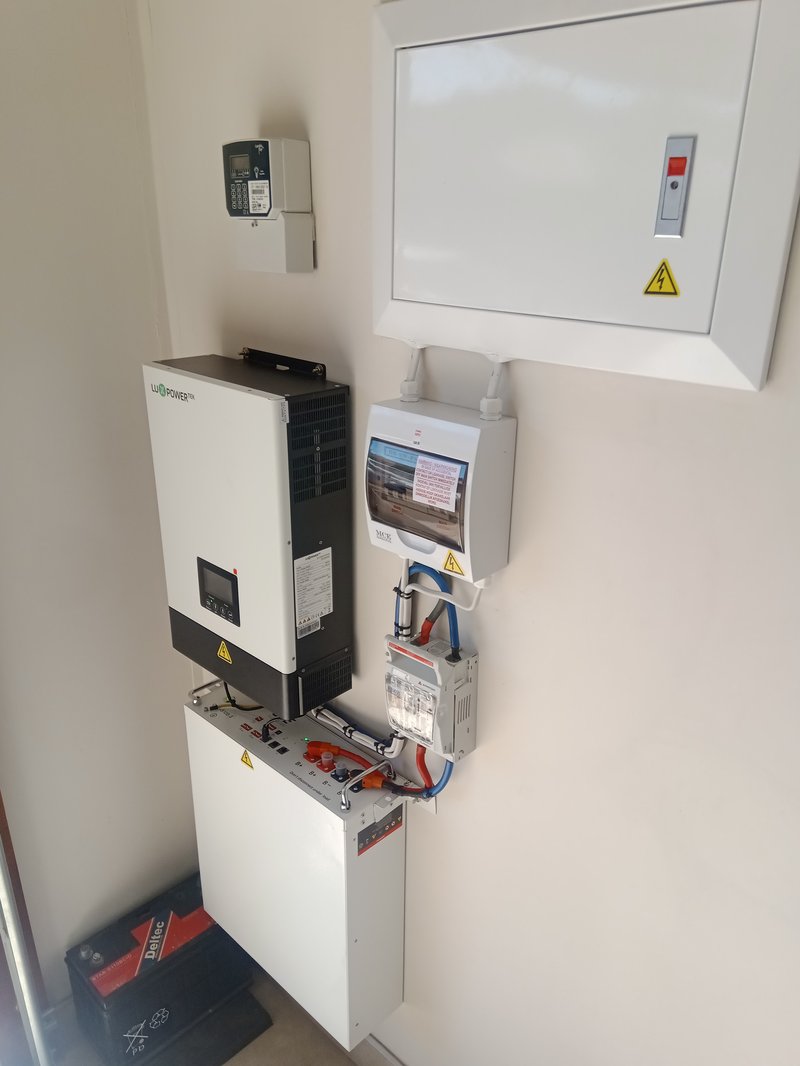 A hybrid inverter (top) paired with a wall-mounted LiFePO4 battery (bottom) — this is the core of a Tier 2 system. Image: Wikimedia Commons, CC BY-SA 4.0

System: 5–8 kWp hybrid + 5–10 kWh battery
This is the sweet spot for most Filipino households. You get the daytime savings of Tier 1, plus brownout backup for essentials. A hybrid inverter manages both solar and battery, so you're covered during outages without needing a separate UPS.
Components:
| Item | Spec | Est. Cost |
|---|---|---|
| Solar panels | 9–15x 550W | ₱4,500–5,000 each |
| Inverter | Deye 5–8kW hybrid | ₱51–85K |
| LFP battery | 1–2x 48V 100Ah (Lazada brands) | ₱35–55K each |
| Grid monitoring | Shelly EM | ~₱2K |
| Mounting + wiring + labor | Full install | ₱60–90K |
Monthly savings: ₱5,000–8,000
ROI payback: 4–6 years
What you can power:
- ✅ Everything in Tier 1
- ✅ 4–8 hour brownout backup
- ✅ Night essentials (fridge, lights, router)
- ✅ Home automation and NAS overnight
- ❌ Full home overnight on battery alone
- ❌ EV charging
Bang for buck: ⭐⭐⭐⭐ (4/5) — Excellent balance of coverage and cost. The hybrid inverter opens the door to future battery expansion without replacing the whole system.
Upgrade path: Add more LFP batteries over time. Add an EV charger when ready. The inverter handles both without replacement.
Tier 3: ₱600K–1M — Near Zero Bill
System: 8–12 kWp hybrid + 10–20 kWh battery + EV-ready
For households with high consumption (multiple aircons, EV, home office), this tier brings your Meralco bill close to zero. The larger battery bank means multi-day brownout survival, and the system can charge an EV on excess solar during the day.
Components:
| Item | Spec | Est. Cost |
|---|---|---|
| Solar panels | 15–22x 550W | ₱4,500–5,000 each |
| Inverter | Huawei SUN2000 8–10kW hybrid or Deye 12kW | ₱65–150K |
| LFP batteries | 2–4x 48V 100Ah | ₱70–140K total |
| EV charger | go-e Charger or OpenEVSE | ₱30–50K |
| Grid monitoring | Shelly Pro 3EM | ~₱4.5K |
| Mounting + wiring + labor | Full install | ₱80–150K |
Monthly savings: ₱8,000–15,000 (near-zero bill achievable for many households)
ROI payback: 5–7 years
What you can power:
- ✅ Full home load (3–5 aircon units)
- ✅ EV charging during daylight
- ✅ Multi-day brownout survival on battery
- ✅ Home automation, NAS, server rack 24/7
- ✅ Near-zero Meralco bill achievable
Bang for buck: ⭐⭐⭐ (3/5) — Excellent coverage, but costs scale faster than savings at this range. Best suited for homes with EVs or very high bills (₱15K+/month).
Upgrade path: Add more batteries to reach full off-grid capability. Integrate with Home Assistant for automated load shifting and grid arbitrage.
Tier 4: ₱1M+ — Full Energy Independence
System: 12+ kWp, 20+ kWh battery, off-grid capable
The premium tier. You're not just reducing your bill — you're building resilience against grid failure, rate hikes, and brownout season. Premium panel brands (Jinko/LONGi N-type), premium inverters (Fronius or Huawei SUN2000), and a large battery bank that can run your home for multiple days without sun.
Components:
| Item | Spec | Est. Cost |
|---|---|---|
| Solar panels | 22+ x 550W+ N-type (Jinko / LONGi) | ₱6,000–8,000 each |
| Inverter | Fronius Symo GEN24 or Huawei SUN2000 | ₱150K+ |
| Battery bank | 20+ kWh LFP (branded: CATL / BYD) | ₱200K+ |
| EV charger | Integrated smart charger | ₱50–80K |
| Monitoring | Shelly Pro 3EM + Emporia Vue | ₱10–15K |
| Mounting + wiring + labor | Premium install | ₱100–200K |
Monthly savings: ₱10,000+ (potentially zero bill)
ROI payback: 7–10 years
What you can power:
- ✅ Complete energy independence
- ✅ Extended off-grid operation (3–5+ days)
- ✅ Full EV fleet charging
- ✅ High-consumption commercial-grade loads
- ✅ Premium reliability with tier-1 components
Bang for buck: ⭐⭐ (2/5) — Diminishing returns compared to Tier 2/3. The premium is mostly for resilience, longevity, and peace of mind — not faster ROI. Worth it if you're in a blackout-prone area or have very high consumption.
Tier Comparison at a Glance
| Tier 1 | Tier 2 | Tier 3 | Tier 4 | |
|---|---|---|---|---|
| Budget | ₱150–300K | ₱300–600K | ₱600K–1M | ₱1M+ |
| System type | Grid-tied | Hybrid | Hybrid + EV | Full independence |
| Savings/month | ₱3–5K | ₱5–8K | ₱8–15K | ₱10K+ |
| ROI payback | 3–4 yrs | 4–6 yrs | 5–7 yrs | 7–10 yrs |
| Brownout backup | ❌ | ✅ 4–8 hr | ✅ Multi-day | ✅ Indefinite |
| Night coverage | ❌ | ✅ Essentials | ✅ Full home | ✅ Full home |
| EV charging | ❌ | ❌ (prep only) | ✅ | ✅ |
| Bang for buck | ⭐⭐⭐⭐⭐ | ⭐⭐⭐⭐ | ⭐⭐⭐ | ⭐⭐ |
You don't have to buy the full system upfront
Start with Tier 1 or 2 and upgrade later. Most components carry over — panels, mounting rails, wiring, and MC4 connectors (waterproof snap-together plugs — like USB but for solar panels) are reusable. The biggest upgrade is swapping a grid-tied inverter for a hybrid one and adding batteries. Plan your roof layout for the maximum panel count you'll ever want, even if you only install half now.
Previous: ← Decision Matrix | Next: Component Deep-Dive →